
AI and high uncertainty are turning strategy into… exploration

A few weeks ago, I was facilitating a strategy workshop for an Australian company. In his opening words, the CEO told his leadership team that he could envision a future where they triple the size of the company in the next 2 to 3 years. But he could also see a scenario where the company shrinks to a third of its current size in the same time frame. This was not a figure of speech. Regulators were contemplating reform and competitors were repositioning. Two developments whose outcomes were still unknown and whose combination could trigger either fast growth or rapid decline.
This might be an extreme situation but it’s not such an isolated case nowadays.
In this article I highlight how the combination of cheap and available artificial intelligence and high uncertainty in the business world is changing the strategy practice in many organisations.
The Explore and Exploit continuum
My Strategyzer friends and I published a contribution to strategy literature, The Invincible Company, in 2020, and the core argument was simple: to build long-term resilience, an organisation has to be good at two things at once, ‘explore’ and ‘exploit’, and those two things are radically different.
When presenting those ideas to leadership teams, we would remind them that however large their company, however many people on the payroll and however many decades of history behind it, their company began as an idea in somebody's head. Someone had a hunch, tested it, captured first revenues and this started the growth journey to the organisation as it stands today. But often, this exploration journey is so distant that it is forgotten.
From there we would usually steer the conversation in two directions: growth and resilience, because they are often the two archetypal strategic objectives in an organisation.
Growth. We would posit that if every established business started as an unproven idea, then their next source of growth is also going to start as an unproven idea, sitting in someone's head somewhere in their organisation right now, unfunded and unnoticed.
Resilience. We would remind everyone that no business model lives forever. Every business model has an expiry date. A leadership team that only invests in the current business is betting everything on that date being so far away that it can be safely ignored. Or, if I allow myself to be cynical, far enough that the expiry problem can be passed on to a future generation of leaders.
At some point in the conversation, we would draw a continuum. On one end, exploit: running, maintaining and optimising the current business. On the other, explore: searching for new business and growth beyond the core. And we would highlight how things are radically different on both ends of the continuum. Different process, investment logic, skills required, different tolerance for failure, decision-making logic, and the list goes on.
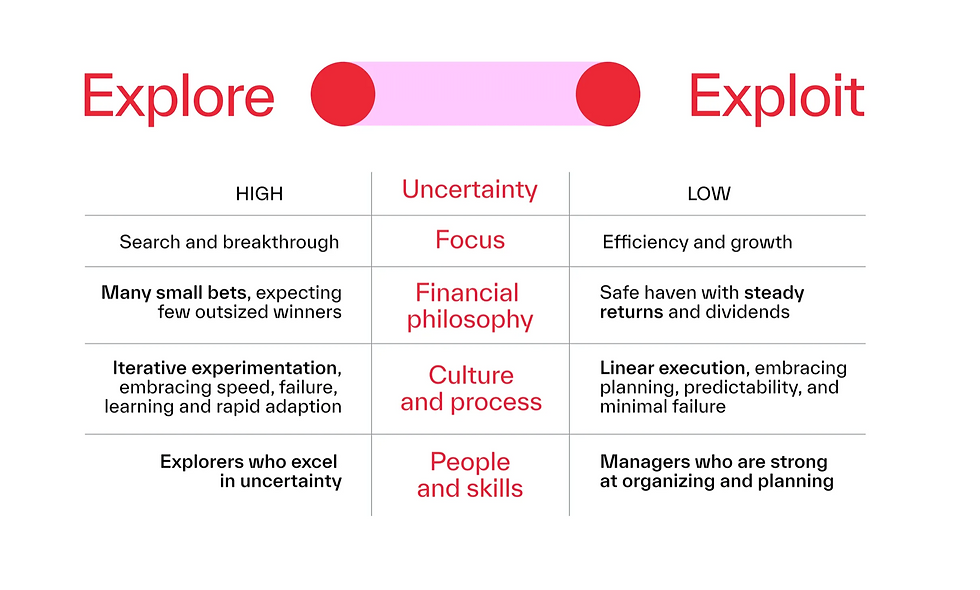
In 2020, in a strategy context, that argument had an important purpose. We were trying to get leadership teams to free up just a little bandwidth and a little money for the explore end of the continuum. It legitimised a limited but real role for innovation: focusing on creating new growth outside the core, and enabling long-term resilience through new products, services or business models that would be ready before the core eventually faltered. A sensible ask. Small, ring-fenced, defensible resources for exploration as an overall insurance policy against decline.
Fast forward to 2026 and two things have changed every strategy conversation we are now involved in.
AI has commoditised access to intelligence
A startup or a small business with an AI subscription can now do strategic research and analysis that would have required a large team and a six-figure budget six years ago. Performance analysis, market sizing, business environment scan, synthesis across hundreds of documents and trends... the capability gap between a global corporation and a small firm on these dimensions has not disappeared entirely but it has almost closed, and it closed quickly.
But access to intelligence with AI is not only democratising strategic analysis; it is also transforming strategic design itself.
Felipe Csaszar makes the argument well in the article AI is Revolutionizing Strategic Decision-Making (September–October 2026 issue of Harvard Business Review). Strategy, he points out, has always been shaped by the limits of the people doing it.
“The tools of strategy were designed around limited human attention, memory, and processing capacity.” Felipe Csaszar
Every framework we use was built as a coping mechanism for bounded rationality. Five forces, three horizons, two-by-two matrices. They exist because a leadership team can hold perhaps five or six serious options in its collective head at once, and needs a way to narrow to those five or six fast. Csaszar calls what is happening now an unbounding of rationality. AI systems can generate, screen and evaluate strategic alternatives at a volume no human process could sustain.
The consequences are already being felt in strategy processes starting now. A few years back, strategy used to look like project management. The strategy process quickly converged on a plan, you resourced it, and you led it through to realisation. Deviation was failure. Now and in the future, strategy will look much more like portfolio management. You hold many options open, you advance several in parallel, and you accept from the outset that most of them will never reach realisation, because their job was to teach you something rather than to be fully executed.
Uncertainty has escaped to the other half of the continuum
In The Invincible Company we highlighted that the single best criterion for deciding whether to take an explore approach or an exploit approach to a problem is the level of uncertainty attached to it.
Launching a new service, built on a technology you have not mastered, for a customer segment you have never served, is a high uncertainty problem. You do not know whether those customers want it (desirability risk), or whether they will pay what’s needed to make it sustainable and profitable (viability risk), or even whether the technology will work (feasibility risk).
On the other hand, building a new factory to extend capacity for your most successful product line, in a region where you have run factories for decades, is a serious corporate undertaking with real execution risk, but it is not a high uncertainty problem. You have built many similar factories in the past. And you know that product sells.
The biggest mistakes we see companies make with innovation often come from treating an explore challenge with the exploit operating model. So, for years, our most useful advice had been to sort strategic challenges into those two piles and treat each differently.
But what happens when the low uncertainty pile empties out and when high uncertainty spreads to every part of a business?
The World Uncertainty Index (WUI) created by Hites Ahir, Nicholas Bloom and Davide Furceri tracks the perceived level of "uncertainty" in the business world. A year ago, in September 2025 the WUI peaked at its highest point since they created the index close to 20 years ago. What I found particularly interesting was that the index was more than twice as high as during COVID, a period during which, at least in Australia, we didn’t know if there would be pasta or toilet paper the next time we went to the supermarket. We didn’t know when would be the next time we’d be able to go more than 5km away from home either, or see a live performance.

A year later, in 2026, the index has gone down but it’s still much higher than during those COVID years. That’s telling. In essence it feels like the whole business world now lives in high uncertainty.
At this level of uncertainty, strategizing feels like “hiking in the fog” for many of our clients. You cannot see far enough ahead to commit resources to anything with confidence. Every strategic move that used to be a planning exercise has become a bet.
How do you do strategy “in the fog”?
The response is not new. In 1984 Richard Pascale published the real story behind Honda's entry into the American motorcycle market. Honda had stumbled in, nearly run out of money, and found the 50cc Supercub by accident. A year later Henry Mintzberg and James Waters named the pattern: emergent strategy, the strategy that forms through action rather than before it. By 1995 Rita McGrath and Ian MacMillan had turned it into a method, discovery-driven planning.
The thinking on ambidextrous organisations - that The Invincible Company book is part of - is built on those foundations.
One of the most influential strategy thought leaders, Clay Christensen used to say that “The best strategy is a balance between having a deliberate one, and a flexible, or emergent strategy.”
So, the thinking is not new. What is new is that the level of uncertainty in the business world has taken an approach that was previously niche, and mostly confined to innovation, and made it the most relevant strategic approach available for clients facing the unprecedented levels of uncertainty.
In practice that means a different strategic discipline involving:
Making the hypotheses underneath each strategic option worth exploring explicit, rather than leaving them buried in the confidence of the person proposing the option,
Testing those hypotheses to validate or invalidate them,
Closing the learning loops from those tests in order to inform decision-makers on the gathered evidence and insights,
Starting with small bets and making further strategic investment decisions based on evidence,
Exploring a large portfolio of strategic options rather than executing "the plan" to be able to adapt quickly to the evolution of the business environment.
By now you can see where this is going. AI has made it possible to manage a large portfolio of strategic options. Uncertainty has made it necessary to work in an emergent way. Put those together and strategy work is looking more and more like exploration.
Six years ago when we published The Invincible Company, our purpose was to convince leadership teams to protect a small amount of bandwidth and money for exploration, against the gravitational pull of the core.
In 2026, leaders are watching the “certain” part of their “exploit” business shrink, quarter by quarter. Even in large organisations, there are fewer areas where things are certain and stable enough to build a strategic plan and then execute it. And the biggest strategic challenge in front of leaders has become an exploration challenge.
Isn’t it ironic? Fewer organisations can afford to fund a standing innovation capability. In many organisations innovation teams have been cut, or quietly defunded across the past few years. And that’s been happening precisely at the moment when the exploration approach those teams enable is becoming critical to reach strategic clarity.
Exploration is the only way forward.
Which way is forward again?
About Fred
Executive advisor on strategy and innovation. Co-author of The Invincible Company, a guide to building resilience in organisations through corporate innovation. The book was shortlisted for the Thinkers50 Strategy Award in 2021.
New perspectives on Strategy, Innovation and AI. Delivered every Full Moon.


